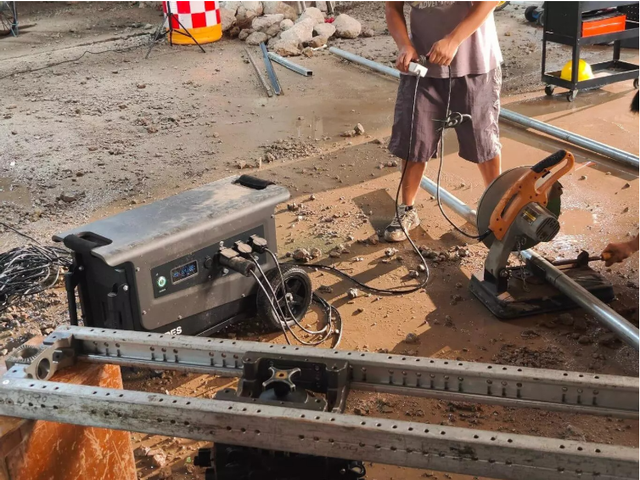
Those who have spent time on construction sites know that the guarantee of reliable power is a luxury. For decades, the answer to the problem of on-site power was to transport a diesel or gas generator, fill up the tank, and make sure it would turn over on the first attempt. This answer was sufficient for the time, but construction sites, crews, and even the tools have evolved. This is where we can have a critical conversation regarding the value of Industrial Power Station.
Instead of a generator that is exposed to the elements, there is now the option of a battery-based power station that is even fully sealed. These rugged battery-based power systems take the place of a traditional generator and don’t require fuel runs, choke adjustments when the weather changes, or produce exhaust fumes. They also function without requiring the ongoing attention and maintenance that traditional generators have.
There is no doubt that traditional generators remain a reliable power supply solution. For some time, generators and diesel-powered power systems performed functions that were unique to them. The difference in what they offer, however, and what modern power systems now offer is becoming smaller to the point that in some cases it is negating the offerings of a generator.
The Basic Problem With Traditional Generators
And of course there are a handful of perennial issues with combustion generators, that if you’ve run one past the one season mark you know deep in your bones. 1st, there’s the fuel. Gasoline and diesel turned generators require a constant source of fuel, which means someone must make runs for fuel, keep fuel on-site safely, and adapt to the prices of fuel fluctuating from one week to another. Lose a diesel delivery out in the boonies and your schedule can grind to a halt.
2nd, there’s noise. A generator that is on for eight hours or ten hours a day is loud enough to make communicating difficult, and on sites that are close to residential neighborhoods, that noise can cause complaints or even run afoul of local ordinances.
Third, there’s maintenance. Oil changes, changing spark plugs, checking the air filter, cleaning the carburetor a generator is a mechanical engine, and a mechanical engine requires maintenance. Miss that maintenance and you’re rolling the dice on a breakdown at the worst possible time.
And last but not least, there’s the weather exposure. Most conventional generators are not made to be left outside in the rain. Crews are now making sheltering by building temporary walls, tarp, lean-to just to shield the unit from moisture, an additional job no one anticipated.
Why Waterproofing Actually Changes the Equation
Yes job sites tend to be outside. Rain, humidity, dust storms, snow, the equipment has to weather whatever the day has for it. A generator that shorts or corrodes because it got rained on is not just an inconvenience, it’s a safety hazard and a hit to your bottom line. A well sealed, weatherproof power station is engineered from the ground up to work in these conditions. The battery packs, inverters, and connection ports are sealed off from moisture, so you’re not going to have to cover the unit or stop your work in the middle of a rain shower. Crews can leave it running in a drizzle, in dirt, or even in humid coastal environments without having to worry about internal rust or short circuits. This is more important than it sounds on paper. Weather delays are among the most common reasons job site schedules slide. If your source of power can continue to run reliably through a rainstorm instead of having to shut down, you are recapturing hours of productive time that would otherwise be lost.
Noise, Fumes, and the Human Side of Job Site Power
Well, specs are a nerd’s tool, and it’s easy to blind yourself with them and forget that people actually have to work next to this stuff every day. A generator humming eight feet away from a crew degrades even rudimentary communication, contributes to fatigue by the end of a shift, and can really get under someone’s skin on a multi-day project.
Battery-powered energy stations, by contrast, are almost silent. No combustion, no engine block tremors, no exhaust fumes wafting the site. For work that’s indoors-adjacent, for cramped city lots or projects next to hospitals, schools or houses, this isn’t a trivial convenience – it can be the difference between continuing to comply with noise regs and getting shut down by a complaint.
And then, there’s the simple issue of the quality of the air. Perhaps best of all, diesel and gas exhaust is not something you want to breathe for hours on end, in enclosed or semi-enclosed quarters. Eliminating that factor is a subtle and meaningful improvement in how a crew ends the day.
Cost, Reliability, and Long-Term Value
The said power station price can look higher than that of an equivalent generator, which is a reasonable thing to consider. But the whole cost picture involves more than the purchase price.
Generators require continued fuel purchases, frequent maintenance parts, and periodic repairs as things inevitably break down. When you’ve charged a power station, you don’t pay for fuel for that cycle, and having fewer moving parts means having fewer potential points of failure. Over a year or two of use, many contractors find that the battery unit ends up winning in cost of ownership, especially when you factor in less time on service calls and downtime.
Reliability is the other half of that equation. Generators fail to start in the cold, they stall in the rain, and they run out of gas. Good power stations turn on immediately, maintain a reliable charge, and care not if it’s 30 or 90 outside.
Where Traditional Generators Still Hold an Edge
To be fair, this isn’t a case where one option wins in every scenario. For extremely long, continuous heavy-load jobs think weeks of nonstop high-draw equipment in a remote location with no grid access, a diesel generator’s ability to simply keep refueling and running indefinitely is hard to match. Battery capacity, even in large industrial units, is finite between charges, and if there’s no way to recharge on-site, that’s a real limitation to plan around.
Larger fleets also sometimes stick with generators because their crews are already trained on maintenance routines and spare parts are easy to source locally. Switching an entire operation over to battery power is a transition, not a flip of a switch, and it makes sense to plan that shift carefully rather than rushing it.
Making the Switch Without the Guesswork
For most standard job sites, residential builds, commercial renovations, event setups, and mid-size commercial projects, the case for moving toward a Waterproof Power Station keeps getting stronger. Less noise, less fuel logistics, less maintenance, and genuine weather resilience add up to fewer headaches for whoever is responsible for keeping the site running.
The smartest approach for most crews is a hybrid one: keep a traditional generator on hand for extreme, long-duration, off-grid situations, but rely on a rugged, weatherproof power station as the primary daily workhorse. That way you get the day-to-day convenience and reliability without giving up the backup capacity for the rare job that truly demands it.
Job site power isn’t going to stop being unpredictable, but the tools available to handle it have genuinely gotten better. Whether the switch happens all at once or gradually, it’s worth taking a real look at what a modern power station can do before defaulting to the same generator that’s always been sitting in the truck bed.
